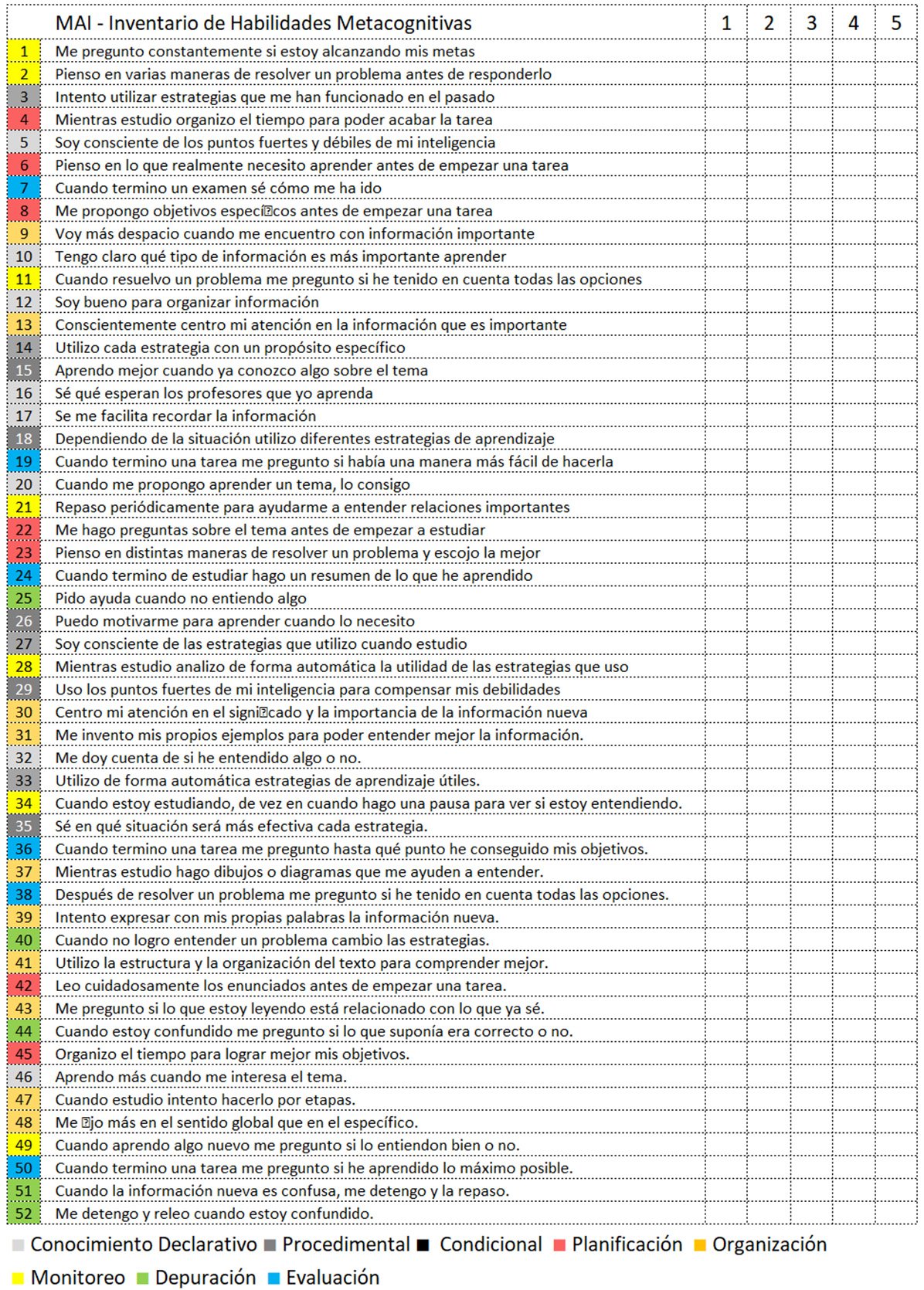
Se concluye que la versión en español del MAI queda validada y puede ser utilizada por docentes e investigadores para conocer las habilidades metacognitivas de jóvenes y adultos.
.
Referencias
aKin, a.; aBaci, r. & ceTin, B. (2007). ‘The Validity and Reliability of the Turkish Version of the Metacognitive Awareness Inventory’. Educational
Sciences: Theory & Practice [7, 2, 671-678].
alci, B. & KaraTas, h. (2011). ‘Teacher candidates’ metacognitive awareness according to their domains and sex’. International Journal of Multidisciplinary Thought [1, 6, 255-263].
BalciKanli, c. (2011). ‘Metacognitive Awareness Inventory for Teachers (MAIT)’. Journal of Research in Educational Psychology [9, 3, 1309-1332].
Brown, a. (1987). ‘Metacognition, executive control, self-regulation and other mysterious mechanisms’. KLUWE W., R. H. (Ed.) Metacognition,
motivation and understandin [65-116].
camPo, a. & oviedo, h. (2008). ‘Propiedades psicométricas de una escala: la consistencia interna. Revista de salud pública [10, 5, 831-839].
cervanTes, V. (2005). ‘Interpretaciones del coeciente alpha de Cronbach’.
Avances en medición [3, 9-28[. corTina, J. (1993). ‘What is Coefcient alpha?’ Journal of Applied Psychology [78, 1, 98-104].
doganay, a. & demir, o. (2011). ‘Comparison of the Level of Using Metacognitive Strategies during Study between High Achieving and LowAchieving Prospective Teachers’. Educationat Sciences: Theory & Practice [11, 4, 2036-2043].
flavell, J. (1976). Metacognitive Aspects of Problem Solving: The Nature of Intelligence. Hillsdale: N. J. Erlbaum.
____ (1979). ‘Metacognition and cognitive monitoring- A new area of cognitive–developmental inquiry’. American Psicology [34, 906-911].
gula, f. & shehzadB, s. (2012). ‘Relationship between metacognition, goal orientation and academic achievement’. Procedia – Social and Behavioral Sciences [47, 1864-1868]. Jaramillo, s. & osses, S. (2012). ‘Validación de un instrumento sobre metacognición para estudiantes de segundo ciclo de educación general básica’. Estudios Pedagógicos [XXXVIII, 2, 117-131]. Jusi, h.; denise, d. & leonar, r. (2006). ‘Perceived Third-Person Effects and Consumer Attitudes on Prevetting and Banning DTC Advertis’. The Journal of Consumer Affairs [40, 1, 90-116].
KaPlan, r. & saccuzzo, d. (2005). Psychological testing: Principles, applications and issues. Wadsworth: Thomson.
KlimenKo, o. & alvarez, J. (2009). ‘Aprender cómo aprendo: la enseñanza de estrategias metacognitivas’. Educación y Educadores [12, 2, 11-28].
magno, c. (2010). ‘The role of metacognitive skills in developing critical thinking’. Metacognition Learning [5, 137-156].
narang, d. & saini, s. (2013). ‘Metacognition and Academic Performance of Rural Adolescents’. Studies on Home and Community Science [7, 3, 167-175].
nunnally, J. (1987). Teoría psicométrica. México: Trillas.
oviedo, h. & camPo, a. (2005). ‘Aproximación al uso del coeciente de alfa de Cronbach’. Revista Colombiana de Psiquiatría [XXXIV, 4, 2005]. ozsoy, g. (2011). ‘An investigation of the relationship between metacognition and mathematics achievement’. Asia Pacic Educ. Rev. [912, 227-235].
Paris, s.; cross, d. & liPson, m. (1984). ‘Informed Strategies for Learning: A Program to Improve Children’s Reading Awareness and Comprehension’. Journal of Educational Psychology [76, 6, 1239-1252].
rahman, f.; Jumani, n. ; saTTi, m. & maliK, m. (2010). ‘Do metacognitively aware teachers make any difference in students’ metacogniton?’ International journal of academic research [2, 6, 219-224].
roces, c.; Tourón, J. & gonzález, m. C. (1995a). ‘Motivación, estrategias de aprendizaje y rendimiento de los alumnos universitarios’. Bordón [47, 1, 107-120].
schraw, g. & dennison, r. (1994). ‘Assessing metacognitive awareness’. Contemporary Educational Psychology [19, 460-475]. schraw, g. & moshman, d. (1995). ‘Metacognitive Theories’. Educational Psychology [7, 351-371].
sezgin, d. (2013). ‘A comparison of metacognitive awareness levels of future elementary teachers in Turkey and USA’. Educational Research and Reviews [8, 6, 277-288].
sPerling, r.; howard, B.; miller l. & murPhy, c. (2002). ‘Measures of Children’s Knowledge and Regulation of Cognition’. Contemporary Educational Psychology [27, 51–79]. sTewarT, P.; cooPer, s. & moulding, l. (2007). ‘Metacognitive Development in Professional Educators’. The Researcher [21, 1, 32-40].
sTreiner, d. (2003). ‘Being Inconsistent About Consistency: When Coefcient Alphas Does and Doesn’t Matter’. Journal of personality assessment [80, 3, 217-222].
Tulving, e. & madigan, s. (1970). ‘Memory and verbal learning’. Annual Review of Psycology [21, 438-476]. ulas, h.; Kolaç, e. & sevim, o. (2011). ‘Metacognition awareness levels of turkish teacher candidates’. e-Journal of New World Sciences Academy [6, 1, 121-134].
young, a. & fry, J. (2008). ‘Metacognitive awareness and academic achievement in college students’. Journal of the Scholarship of Teaching and Learning [8, 2, 1-10].
Fuente:
https://www.researchgate.net/publication/301923867_Validacion_del_instrumento_’inventario_de_habilidades_metacognitivas_Mai’_con_estudiantes_colombianos